
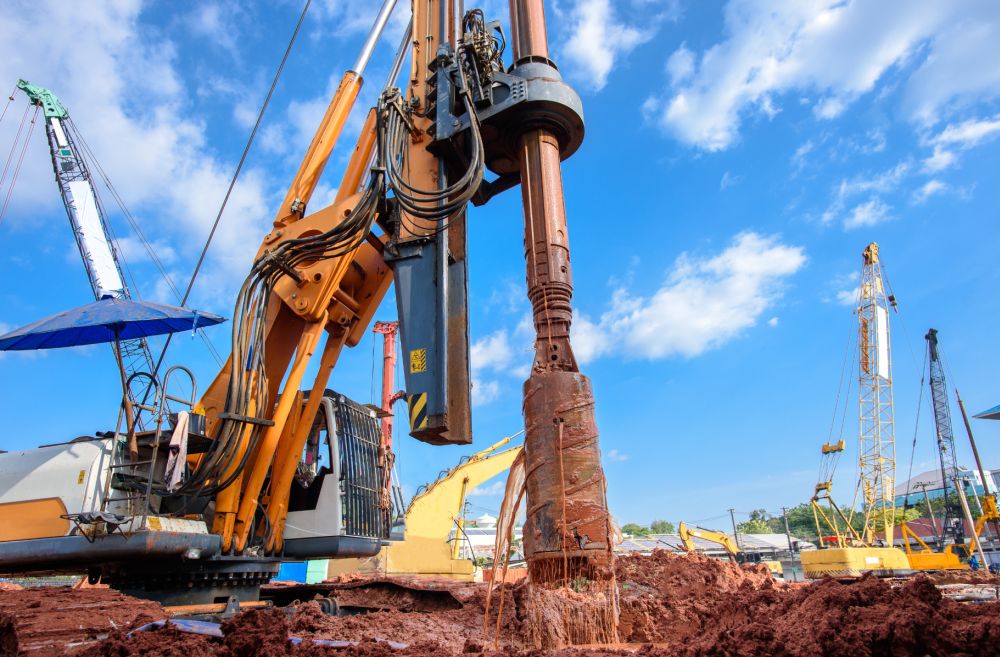
Key Components of a Pile Drilling Machine and Their Roles
Introduction
In modern foundation engineering, deep excavation work requires highly specialized equipment capable of delivering precision, strength, and operational efficiency. These machines are designed to handle challenging soil conditions while ensuring that structures are built on stable and load-bearing foundations.
A pile drilling machine is one of the most essential tools used in this process, combining mechanical power and hydraulic systems to drill deep boreholes that later form reinforced concrete piles for large-scale construction projects.
Understanding the Structure of a Pile Drilling Machine
A pile drilling machine is a complex assembly of mechanical, hydraulic, and electronic systems designed to perform deep foundation drilling with accuracy. Its structure is engineered to ensure stability during operation while maintaining high torque output for penetrating different soil layers such as clay, sand, gravel, and rock fragments.
Each component of the machine plays a specific role in ensuring smooth drilling operations, reducing vibration, and maintaining vertical alignment throughout the excavation process.
Drilling Mast: The Structural Backbone
The drilling mast is one of the most visible and important components of the machine. It acts as the vertical guide frame that supports and stabilizes the drilling system.
Its primary functions include:
- Maintaining vertical alignment of the drilling tool
- Supporting the weight of the rotary head and auger
- Providing structural stability during deep drilling operations
A strong and well-designed mast ensures accuracy in borehole creation, which is critical for foundation integrity.
Power System: Driving Force of the Machine
The power system is responsible for generating the energy required to operate all mechanical functions of the drilling machine. Most modern systems use hydraulic power for better control and efficiency.
Key roles of the power system include:
- Supplying torque for drilling operations
- Operating hydraulic cylinders for movement and lifting
- Ensuring consistent performance under heavy load conditions
Without a reliable power system, deep drilling operations would not achieve the required depth and efficiency.
Rotary Head: Core Drilling Mechanism
The rotary head is the component that directly transfers rotational force to the drilling tool. It is essential for cutting through soil layers and advancing the borehole depth.
Its main functions include:
- Providing controlled rotational movement
- Transmitting torque to the auger or drill bit
- Allowing adjustment of speed based on soil type
This component plays a crucial role in ensuring smooth penetration and efficient soil removal.
Auger or Drilling Tool: Soil Excavation Element
The auger or drilling tool is responsible for physically cutting and removing soil from the ground. It is available in different designs depending on the soil conditions and project requirements.
Functions include:
- Excavating soil during rotation
- Transporting loosened material to the surface
- Enabling deep borehole formation with minimal disturbance
Different auger types are used for clay, sand, and mixed soil conditions to improve efficiency.
Hydraulic System: Precision and Control Unit
The hydraulic system is the operational core that ensures smooth movement and precise control of the machine’s components. It allows operators to manage drilling speed, pressure, and direction effectively.
Key functions include:
- Controlling lifting and lowering of drilling tools
- Regulating torque and pressure levels
- Enhancing operational safety and stability
Hydraulic technology also helps reduce mechanical wear and improves machine durability.
Control System: Operator Interface
The control system allows operators to manage the entire drilling process from a centralized panel. It integrates sensors, monitors, and electronic controls for precision operation.
Its roles include:
- Monitoring drilling depth and alignment
- Adjusting operational parameters in real time
- Ensuring safety through automated alerts and controls
Modern systems often include digital displays for improved accuracy and ease of use.
Chassis and Mobility System
The chassis forms the base structure of the machine, supporting all components and allowing movement across construction sites. Depending on the design, it may be crawler-based or truck-mounted.
Its main functions include:
- Providing stability during drilling operations
- Enabling mobility across rough terrain
- Supporting the overall machine weight and load distribution
A stable chassis ensures safe and efficient operation in different site conditions.
Conclusion
The efficiency of deep foundation work depends heavily on the performance of each component within a drilling system. From the mast and rotary head to the hydraulic and control systems, every part plays a vital role in ensuring accuracy, stability, and productivity.
Understanding these components helps engineers and construction professionals make informed decisions when selecting and operating drilling equipment for complex infrastructure projects.